
Chattahoochee County Arrest Records and Court Charges
Chattahoochee County arrest records start with law enforcement. The Sheriff's Office handles arrests, jail, incident reports, crash reports, local criminal-history requests, and open-records requests. An arrest record can identify the arrest event and the law-enforcement record behind it, but it does not prove guilt. It also does not always show the final court result. The court charge record begins when the prosecutor or court process files formal charges that are tracked in the criminal case.
The court-charge path is separate from the booking path. For current custody or jail questions, the county did not publish an official online jail roster in the research, so the sheriff phone channel is important. For the full case file, disposition, plea, sentence, and certified court proof, use Chattahoochee County criminal court records. This page stays focused on the arrest-to-charges pathway and how charge status changes after an arrest.
How to Find Chattahoochee County Arrest Records
The most concrete online sheriff channel located in the research is the Chattahoochee Sheriff's open-records form. It accepts requests for 911 recordings, incident reports, accident reports, calls for service lists, CAD reports, crime statistics, personal files, disciplinary files, photographs, bodycam video, and other records. The form promises a response within three business days with an estimated completion time and cost. It is not an active booking search and should not be treated as a live mugshot database.
The open-records form is one of the successful manifest images for Chattahoochee County arrest records and charges. It shows why arrest-related records are handled through the sheriff's records process rather than the court docket alone.
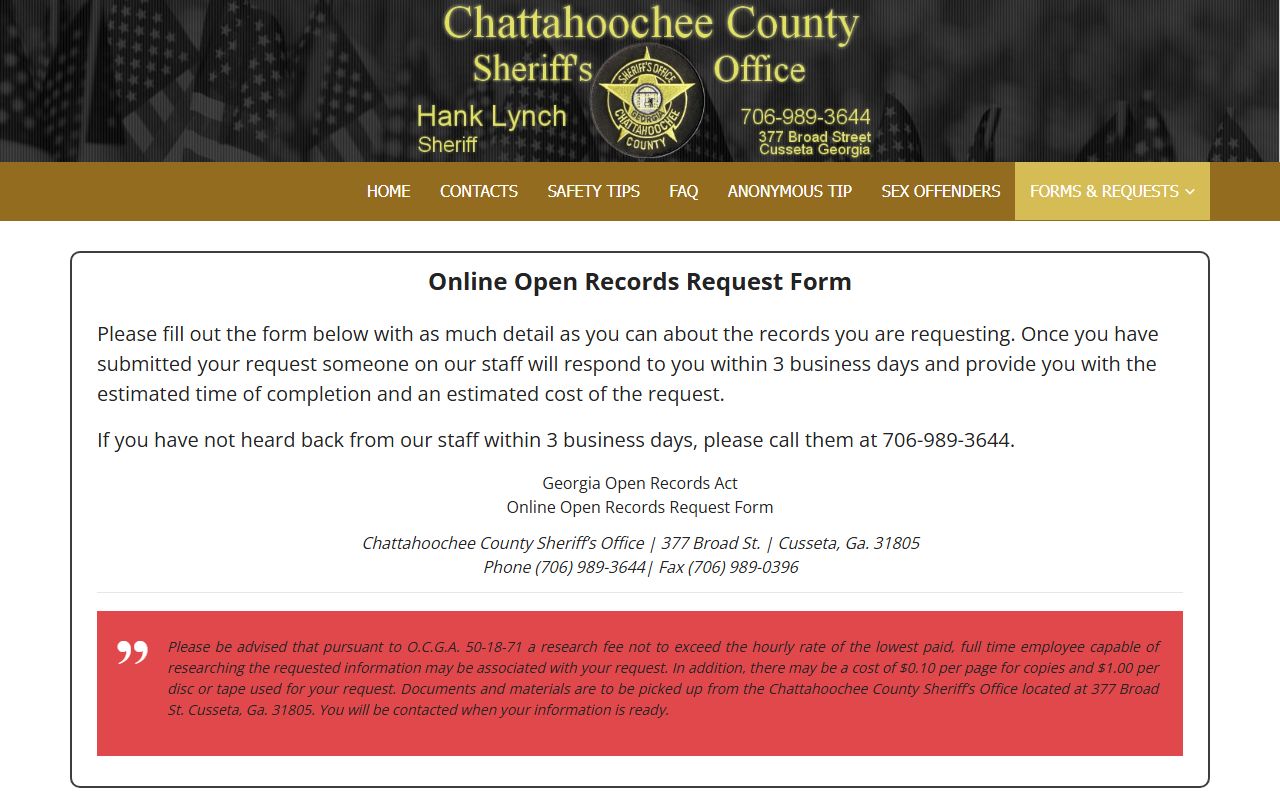
Use the form for law-enforcement records when the issue is an arrest report, incident report, accident report, call record, photograph, or bodycam item. Use the court or clerk when the issue is the charge filed in court, a plea, a dismissal, or a sentence.
| Form Field | Type | Purpose |
|---|---|---|
| Your Name, Email, Phone, Address | Requester details | Identifies the person requesting sheriff records. |
| Requested Documents | Checkbox options | Selects 911 recordings, reports, CAD, photos, bodycam video, or other records. |
| Case Number(s) | Text | Helps staff locate a known arrest, incident, or report. |
| Incident Date / Date Range | Date text | Narrows the requested arrest or law-enforcement event. |
| Location of Incident | Text | Connects the record request to a place in Chattahoochee County. |
| Court Case Pending? | Yes / No | Flags records that may be affected by an active prosecution. |
Chattahoochee County Arrest Records Check
The sheriff's FAQ and local criminal-record-check PDF create a second route for arrest-record questions. The local check is for Chattahoochee County only. The form asks for applicant name, alias or maiden name, date of birth, Social Security number, address, phone number, applicant signature, date, and a copy of a state driver's license. The results section allows Record Found with copy included or No Record Found, signed by the Records Division.
The Sheriff's FAQ is the second successful image for this assigned page. It documents practical sheriff records details, including report-copy and local criminal-history information.
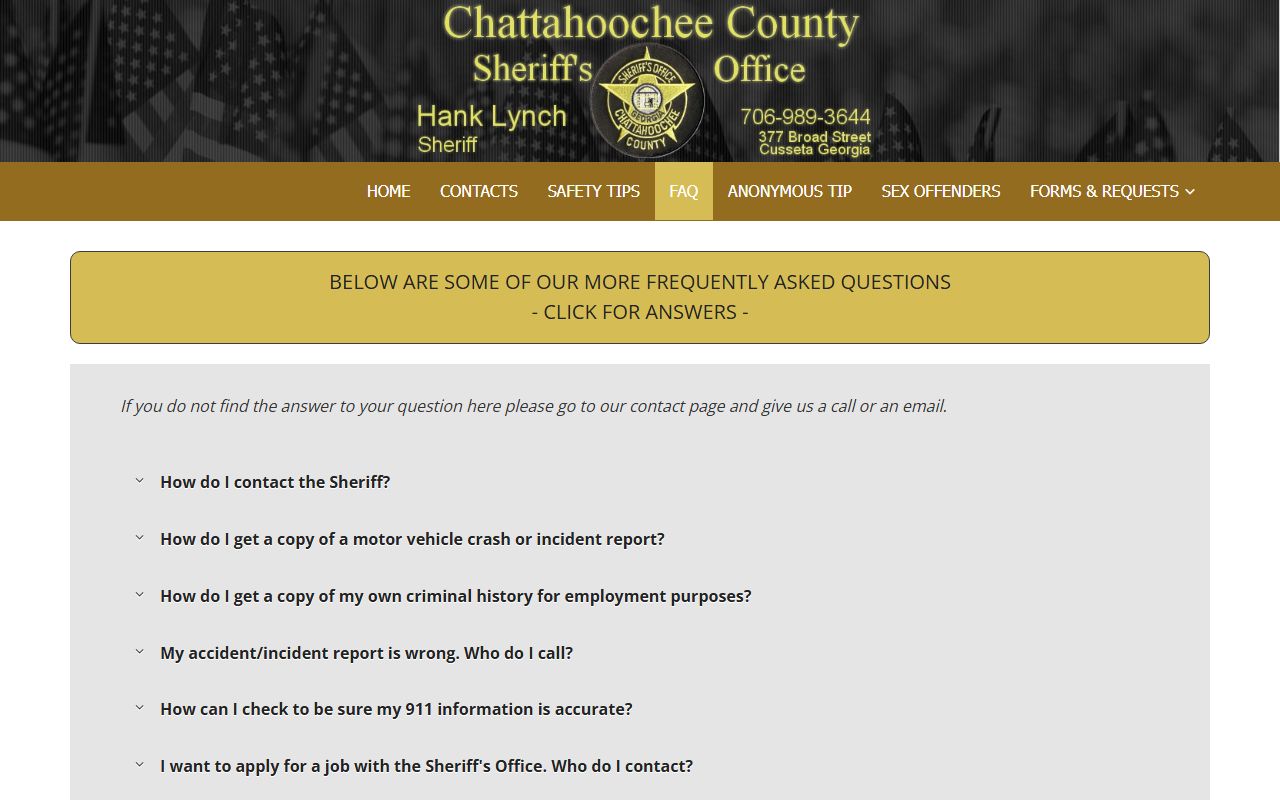
The FAQ says a local criminal-history check for the requester's own employment purposes costs $5.00 cash only and requires government photo ID. That local result is not a statewide criminal-history report and is not the same as a certified court disposition.
Chattahoochee County Charges After Arrest
Court charges after arrest are shaped by the prosecutor and the court system. The Chattahoochee Judicial Circuit District Attorney handles felony prosecution for the circuit, while Magistrate Court handles warrants, first appearances, and preliminary matters. Superior Court handles felony cases. A person may be arrested on one suspected offense, but the formal court charges may be different after review. Charges can be added, amended, reduced, dismissed, or replaced by a later accusation or indictment.
A charge record should be read charge by charge. One arrest can produce several counts. One count can remain pending while another is dismissed. A felony may start with a warrant or first appearance before the prosecutor files a formal charging document in Superior Court. A misdemeanor traffic matter may route to Probate Court in Chattahoochee County because that office administers misdemeanor traffic court.
Arrest-to-charge flow: Arrest › Booking or sheriff record › First appearance or warrant event › Prosecutor review › Accusation, complaint, or indictment › Court docket › Disposition
Chattahoochee County Charging Documents
The charging document is the formal record that brings the alleged offense into the court case. Georgia criminal practice may use accusations, indictments, complaints, warrants, and related documents depending on the charge and court. The exact label matters because it can tell whether the case is still early, whether a prosecutor has filed it, or whether a grand jury has returned an indictment.
| Document | Who Uses It | What It Means for Court Charges |
|---|---|---|
| Complaint or warrant-related filing | Law enforcement, magistrate process, or prosecutor depending on context. | Often appears early and may support arrest, first appearance, or preliminary review. |
| Accusation | Prosecutor | Formal prosecutor-filed charging document used to move charges through court. |
| Indictment | Grand jury | Formal felony charging document returned after grand-jury action. |
Chattahoochee County Charge Status
Charge status is the most important part of reading court charges after arrest. A pending charge is not a conviction. A dismissed charge is not the same as a guilty plea. Nolle prosequi means the prosecutor is not proceeding on that charge at that time. A reduced charge means the original accusation changed to a lesser offense or different count. Each charge must be read with its own final line.
| Status | What It Means | Search Caution |
|---|---|---|
| Pending | The charge remains open and has not reached final disposition. | Do not treat it as proof of guilt. |
| Amended | The charge text, count, severity, or offense was changed. | Compare the original and current charge before drawing conclusions. |
| Reduced | The offense level or count changed to a lesser charge. | Read the sentence and final disposition, not only the arrest charge. |
| Dismissed | The court or prosecutor ended that charge without conviction. | Other charges in the same case may still have different outcomes. |
| Nolle prosequi | The prosecutor declined to proceed on that charge at that time. | Confirm whether any related counts remained active. |
| Convicted | The charge ended in a guilty plea, verdict, or other finding of guilt. | Check the sentence, probation, fines, and appeal posture. |
Chattahoochee Charges vs Convictions
The difference between a charge and a conviction is central to Chattahoochee County arrest records. An arrest record may list suspected offenses or report details. A court charge record lists what was filed. A conviction is the result after a plea, verdict, or court finding. The same person can have an arrest, a filed charge, a dismissed count, and a conviction on another count in one case.
| Point | Charge | Conviction |
|---|---|---|
| Stage | Accusation after arrest or prosecutor review. | Final guilt finding by plea, verdict, or court action. |
| Proof level | Enough basis to file or pursue the allegation. | Resolved under criminal proof and court process. |
| Where to verify | Charging document, docket, clerk, prosecutor, or court calendar. | Disposition, judgment, sentence, certified court copy. |
| Practical warning | A pending or dismissed charge should not be called a conviction. | A conviction should still be read by exact offense and sentence. |
Open Records Limits on Arrest Records
Georgia's Open Records Act supports inspection and copying of public records, but arrest records and court charges can be limited by active investigations, pending prosecution, safety concerns, sealed warrants, protected witness or victim information, juvenile confidentiality, and redaction rules. The sheriff's form asks whether a court case is pending because that fact can affect release decisions. A request can receive a cost estimate, partial release, denial, or delayed completion depending on the record.
Sheriff copy fees found in the research include $0.10 per page and $1.00 per disc or tape, with research time charged up to the hourly rate of the lowest-paid full-time employee capable of researching the request. The sheriff FAQ also says non-parties to a crash may not be able to pick up a report, and report corrections should first go to the deputy who prepared the report. Facts can be corrected, but accurate facts will not be altered.
Note: A denied or redacted sheriff record does not prove there is no related court case.
GBI Restriction for Arrest Records
Record restriction is Georgia's process for limiting certain criminal-history access for non-criminal-justice purposes. The GBI cites O.C.G.A. 35-3-37. For arrests after July 1, 2013, GBI says there is no application process through the arresting agency and the person must contact the prosecutor to have eligible records restricted. For arrests before July 1, 2013, the person applies through the arresting agency.
In Chattahoochee County, that means a local arrest may involve the Sheriff's Office for older arresting-agency steps and the Chattahoochee Judicial Circuit District Attorney for prosecutor approval. Court-file sealing can still require a petition or order in the court where the case was handled. Restriction is not physical destruction. Law enforcement and authorized agencies may still have access.
| Record Type | What Happens | Where Chattahoochee Users Start |
|---|---|---|
| Sealed court file | Hidden from general public access by law or court order. | Clerk or court where the case was handled. |
| Restricted criminal history | Limited for non-criminal-justice purposes under Georgia process. | Prosecutor for post-July 1, 2013 arrests; arresting agency for older arrests. |
| Redacted sheriff record | Public copy released with protected details removed. | Sheriff open-records form or records division. |
Chattahoochee Arrest Records Contacts
Use the office that owns the record. The Sheriff's Office is the right source for incident reports, crash reports, law-enforcement records, local criminal-history checks, and custody questions. The Clerk of Superior Court is the right source for filed criminal case records, docket entries, dispositions, and certified court documents. The Chattahoochee Judicial Circuit District Attorney is tied to felony charging decisions, victim-witness services, and prosecutor review for eligible restrictions.
Chattahoochee Judicial Circuit DA
Government Center
100 10th St., Columbus, GA 31901
706-653-4336